It has been nearly nine years (!) since I last posted on Whosoever Desires, as other endeavors kept me from blogging. Nonetheless, I remember the enterprise—and especially our regular readers—with affection. It occurs to me that some of those readers might like to know that I’ve returned to posting on the web, albeit in a much less ambitious format than Whosoever Desires—just a page to keep friends apprised of my writing and work. Since some who once frequented these haunts might be interested, here’s the new address:
New endeavors
February 28, 2022
 1 Comment |
  Society of Jesus (Jesuits) | Tagged: Jesuits |
  Permalink
 Posted by Anthony Lusvardi, SJ
Why the Last Supper Was Not the First Mass
March 26, 2013 The purpose of this post is to follow up my last one on why the Last Supper was not the First Mass. The next post on Holy Thursday will try to explain exactly what it was: An eschatological banquet enacting a surrogate for sacrifice. But first things first. Four points:
1. A Mass requires the whole Paschal Mystery. The Mass is an anamnetic moment. It is a moment in which the believing community is brought back to the dynamic movement of the Paschal Mystery so as to enter into that moment and imitate the loving self-sacrificial actions of Christ.
Side note: There has been a danger in post-Tridentine theology to speak of the Mass as a re-presentation of the sacrifice of Christ. But this interpretation both fails to take the book of Hebrews seriously and also misunderstands the Jewish concept of “remembrance,” azkarah. Jewish remembrance does not mean that the past event is brought into the present and enacted again. Rather, it means that those who partake in the ritual action are themselves re-presented to the past event. At the Mass, the community of believers becomes present to the Paschal Mystery. Christ is not re-offered or re-presented on the altar of the priest. Rather, the believing community is re-presented to the sacrifice of Christ and, through the power of the Spirit, made part of that self-offering to the Father. Side note over.
The Mass is a memorial of the Paschal mystery. But without that mystery, there could not be a Mass at the Last Supper.
2. A Mass requires the Resurrection. Read the rest of this entry »
23 Comments | Society of Jesus (Jesuits) | Permalink
Posted by Nathan O'Halloran, SJ
Say it ain’t so, Joe
February 19, 2013
I’m sometimes asked by artless, though usually fairly harmless, people, “Are there some Church teachings you don’t believe?” I resist the urge to respond with equal tactlessness, “Are there things about your wife you don’t love?” The question itself reveals just how much political paradigms have distorted our ways of thinking and speaking about the Church, as if the deposit of faith were somehow equivalent to a party platform.
And yet—here you have it, Mr. Artless Questioner—this week I find myself ready to dissent publicly—for all the web to see—from an official act of the Vicar of Christ, the Supreme Pontiff, the Successor of the Apostle Peter.
Benedict XVI, do you have to go so soon?
I agree, to be sure, with all the generous things that have been said about the pope’s decision—that it’s a selfless and humble act, the fruit of great prayer and faith, born out of a profound love of the Church. Of course, it is. And of course Pope Benedict is a better judge of his own limits and abilities than anyone else and is also in a better position to judge the needs of the Church than some two-bit blogger from South Dakota.
But still, I can’t help but thinking, Benedict at 75% is still better than most of us at 100%. Who else combines Benedict’s spiritual and intellectual breadth and depth, his combination of scholarly incisiveness and gentleness of spirit? Who else has better seen through the pomps and empty promises of secularism or proposed so insistently, so clearly their remedy—friendship with Jesus Christ? Who else has Benedict’s sense of the liturgy, sense of history, sense of prayer? Couldn’t he just stay on for another year or two? Couldn’t he at least have waited until after finishing that encyclical on faith? Read the rest of this entry »
11 Comments | Benedict XVI, Liturgy, Priesthood, Society of Jesus (Jesuits) | Tagged: ash wednesday mass, Benedict XVI, joseph ratzinger, papal resignation, spirit of the liturgy | Permalink
Posted by Anthony Lusvardi, SJ
Prologue: A City “Beyond” Religion
January 30, 2013Ironically for a trip that was meant to focus on the interaction of various religions with one another, particularly Hinduism and Catholicism, the first place we visited was a small city/state called Auroville and had little to do with religion or Hinduism. Ironically, because Auroville claims to be a spiritual community that lives “beyond” religion. It is the Disney World of “spiritual but not religious.” We were taken around the place by a woman named Lisa, a woman of German descent (with blonde hair in the picture) who had been born in the Auroville community.
 You can read all about Auroville, its founding by Sri Aurobindo and The Mother, its split with the Aurobindo Ashram and the technicalities of its functioning all online. What I would like to reflect on is this claim of being a community beyond religion. In essence what this means for the community of 2000 plus who live in the city – a city that is under construction for 50,000 – is that no religion in particular is taught in any of the classes. Children can opt to go to workshops about religions, but none of them are mandatory. There are no rituals. Everyone experiences the Feminine Spirit in whatever way that they feel free doing. Read the rest of this entry »
2 Comments | Society of Jesus (Jesuits) | Permalink
Posted by Nathan O'Halloran, SJ
A Prayer for Discernment
January 24, 2013Over the next several weeks, I would like to share with you all some of my reflections on the three weeks that I recently spent in India on a theological immersion into Hinduism. These reflections are both spiritual and theological, personal and social. The purpose is to clarify my own very undeveloped thoughts on many of these matters, so I wholeheartedly welcome comments and dialogue for clarification.
I applied for this course along with the trip to India for one reason: to reflect academically and spiritually on the presence of God, on the “rays of truth” as Nostra Aetate puts it, that are to be found in the Hindu religion. I went to India convinced that discernment of those rays is no mere academic exercise. Unless one is willing to pray with those of other religions, one will never be able to discover the presence of God within them.
And yet I went with some trepidation as well. Although I have studied Islam briefly previously, I really have very little experience of other religions. And while Islam worships the historical God of Abraham, Allah, to whom I’ve never had any trouble praying, the Hindu pantheon of gods presents to me a greater challenge. What I needed was wisdom and discernment, and for this throughout the trip I prayed. Read the rest of this entry »
2 Comments | Society of Jesus (Jesuits) | Permalink
Posted by Nathan O'Halloran, SJ
Asking To Hold the Baby Jesus
December 24, 2012
I couldn’t wait till midnight. I was on my first 30-day retreat as a Jesuit in the Novitiate, and tonight at midnight I was going to ask Mary in my imagination while doing Ignatian contemplation to hold the baby Jesus in my arms. I was so excited. I had been waiting a long time for this.
Finally the moment came, and I asked her if I could hold Jesus. And she said… “no.” Sort of stunned I asked, “why not?” She answered, “because you’re not gentle enough.” That answer has stuck with me over the years and has taken on new meanings in each new ministerial context. How am I called to be gentle, to be an appropriate comforter with gentle arms for the child Jesus in each new person I meet?
Maybe this Christmas can be a good time for you too to ask Mary if you can hold her baby in your arms and see what she says.
(BTW, this picture of of Mary, Joseph and Jesus is my favorite Nativity picture)
3 Comments | Society of Jesus (Jesuits) | Permalink
Posted by Nathan O'Halloran, SJ
Benedict’s Book: An Appraisal
December 20, 2012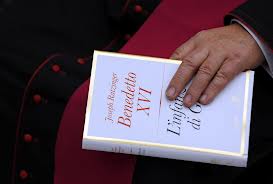 Now that the secular media has completed its rants about how Joseph Ratzinger (Benedict XVI) destroyed Christmas, the time has come to engage more seriously the accomplishment of Ratzinger in his new book The Infancy Narratives. What is the overall merit of his project? Let me begin by saying that the spiritual reflections Ratzinger offers throughout the book are well worth anyone’s read. I was deeply moved, for instance, by his reflections on the Annunciation, and by his insightful commentary on the fact that while, in Mary’s society, women were not allowed to express their own consent to betrothal, God asks of Mary her consent to be the Mother of God. Yet at the risk of being labeled one of those Scripture scholars who happily point the Magi towards their destination but do not deign to follow themselves, as Ratzinger comments on the Jewish Scribes in Matthew 2:4-9, I feel it necessary to offer my critique of Ratzinger’s project as a whole. Read the rest of this entry »
8 Comments | Society of Jesus (Jesuits) | Permalink
Posted by Nathan O'Halloran, SJ
Mary: Our Voice, God’s Voice
December 13, 2012Having completed two of my favorite Marian days of the year, the feasts of the Immaculate Conception and of Our Lady of Guadalupe, I can take a moment now to pause and reflect on what they mean together.
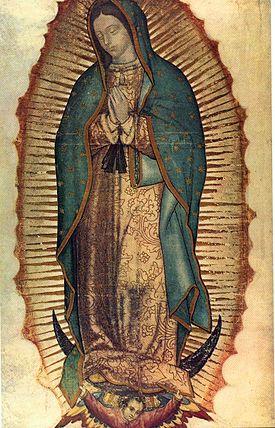
In the Immaculate Conception, Mary speaks for humanity. That, I believe, is the deepest meaning of the Immaculate Conception. Not freedom from some kind “stain” of original sin, but the completely free capacity to speak a full and resounding “Yes” on behalf of the human race.
Narrative criticism has helpfully illuminated this point in its re-readings of the Genesis 3 myth. According to Genesis 3:20, Eve is named havva, But as Reuven Kimelman points out, hayya is the word that means “life-bearer.” This verse is totally out of place where it is unless there is more to it, coming as it does at the climax of story. And sure enough, havva is chosen because of its double meaning as “speech” and because of its etymological connection to the word for serpent, hivya. Havva is a neologism created by the author to combine the words hayya and hivya. Eve becomes, at the end of the story, the speech of every human being influenced as it constantly is, by both the voice of the serpent and the command of God. Eve bears within her both serpent and mother, and as such her speech represents the whole human race. We are all Eve.
What makes the Immaculate Conception so meaningful is that Mary, traditionally called the New Eve, speaks a pure speech, a speech untouched by the serpent that is inside of each one of us. Read the rest of this entry »
Leave a Comment » | Society of Jesus (Jesuits) | Permalink
Posted by Nathan O'Halloran, SJ
Immaculate Misconceptions
December 6, 2012Saturday’s Holy Day of Obligation means a back-to-back Sunday Mass schedule for me (with a prize bingo thrown in there in between), so I didn’t have time for a new post. But I dug up an old one instead, which answers that age old question, “Whose conception is it anyway?” We discussed the same question last night in my RCIA class–a group that is always a joy–and we had a quite few laughs. But the group began by shouting “Jesus!” in answer to the above question and ended by shouting “Mary!”, so I was happy where we ended up. Here it is, my own, feeble attempt an an explanation:
 There always seems to be a bit of confusion around this week’s Solemnity. Despite falling in the middle of Advent, December 8 is not a celebration of the conception of Jesus—which would have meant a remarkably brief pregnancy—but of Mary.
Still, even if we remember whose life it is we’re celebrating, that doesn’t clear up every mystery about the Immaculate Conception. I must confess that for most of my life even though I knew we had to go to church on December 8, I wasn’t exactly sure why. It had something to do with one of those Marian dogmas, I knew, but most Catholics tiptoe around those nowadays for fear of offending the Protestants. And even though I, being a somewhat contrarian lad, was prepared to pick Mary over the Protestants, I really had no idea why.
Even today, while I know a bit more about theology, I still have to admit to finding this particular Mystery particularly mysterious. Among the writing I’ve found shedding light on the subject is an excellent essay titled “The Immaculate Conception” by the British Thomist, Herbert McCabe, OP.
Leave a Comment » | Herbert McCabe, Hope, Immaculate Conception, Society of Jesus (Jesuits) | Tagged: Holy Day of Obligation, homily for immaculate conception | Permalink
Posted by Anthony Lusvardi, SJ
Letting the King be king
November 26, 2012
Sunday’s Solemnity of Christ the King comes between the memorials of two of my favorite Jesuit martyrs, Bl. Miguel Pro (Nov. 23) and St. Edmund Campion (Dec. 1). These priests were killed in the religious persecution of twentieth century Mexico and sixteenth century England respectively. The proximity of these feast days reminds me of the issue that has lately been atop the list of the American bishops’ concerns: religious liberty.
I was asked to give a reflection for a community gathering on the feast of Miguel Pro, and as I thought about his life and martyrdom the question that I couldn’t shake was: why are American Catholics not more concerned about religious liberty? Catholic institutions have already been shuttered in Illinois and Massachusetts, and powerful cultural voices are explicitly calling for the exclusion of Christianity from the public square. Pro’s death occurred less than a century ago and on this continent. Do we think it cannot happen here? Why do American Catholics seem so sleepy?
There are obvious answers: the indifference (and often hostility) of the media; a general climate of secularism and religious indifferentism; political commitments that make raising the question uncomfortable for some, especially in an election year. But it’s perhaps more instructive to look a bit deeper, at attitudes ingrained in our American outlook that make us drowsy when it comes to religious liberty. Among other factors, three modern myths stand out. Read the rest of this entry »
7 Comments | martyrdom, Modernity, politics, religious freedom, Religious liberty, Secularism, Society of Jesus (Jesuits) | Tagged: Christ the King, Edmund Campion, Miguel Pro | Permalink
Posted by Anthony Lusvardi, SJ
House’s Christian ending
November 20, 2012
I don’t have much time for television in my current job, but parishes or no parishes, I haven’t been able to give up House, MD. The show ended last year but I’ve been watching it on Netflix—I march at my own pace, as readers here know—and last week I reached the final episode.
Dr. House, as viewers can attest, is a difficult man to like. A drug addict, a cynic, a master-manipulator, he shows glib disregard for the feelings, beliefs, and even human rights of others. He has a penchant for insulting patients and destroying relationships with anyone who dares to get close to him. A difficult man to like, yes—but I like a challenge.
The genius of the show comes from the character’s complexity, the fact that House needs relationships even as he unconsciously (and sometimes consciously) burns the ones he has. His colleagues (and viewers) see through his frequent, and slightly too insistent, assertions that curing patients for him is only a matter of solving puzzles. And a great deal of his off-putting-ness comes from the fact that he says things that are true, or uncomfortably close to the truth, but socially unacceptable. Read the rest of this entry »
3 Comments | Benedict XVI, Death, Heaven, Hugh Laurie, Society of Jesus (Jesuits), television | Tagged: friendship, Hell, House, MD | Permalink
Posted by Anthony Lusvardi, SJ
Number One
November 18, 2012
My soul proclaims the greatness of the Lord,
my spirit rejoices in God my Savior
for he has looked with favor on his lowly servant.
From this day all generations will call me blessed:
the Almighty has done great things for me,
and holy is his Name.
He has mercy on those who fear him
in every generation.
He has shown the strength of this arm,
he has scattered the proud in their conceit.
He has cast down the mighty from their thrones,
and has lifted up the lowly.
He has filled the hungry with good things,
and the rich he has sent away empty.
He has come to the help of his servant Israel
for he has remembered his promise of mercy,
the promise he made to our fathers,
to Abraham and his children for ever. (Luke 1:46-55)
OK, maybe it’s not that big an event. But, boy, it feels good.
AL, SJ
3 Comments | Football, Notre Dame, Society of Jesus (Jesuits) | Permalink
Posted by Anthony Lusvardi, SJ
More on Mormons…
November 12, 2012 My good friend Rachel Lu has published an intriguing piece on the “Mormon Moment” created by Mitt Romney’s candidacy for president on the First Things blog. Rachel’s thoughtfulness and unique perspective on all things religious, political, and cultural make her a scholar and commentator to watch. Her piece addresses the contentious question of whether Mormons are really Christians by asking, “Do Mormons really want to be Christians?” And then she goes on to explore why Mormonism presents such a unique challenge to today’s orthodox Christians.
While many of us might be tempted to simply dismiss Mormonism as a weird aberration, making jokes about the magic underwear and polygamy, Rachel points out that the Catholic Church has long benefited from serious engagement with other such “heresies of an older style.” I continue to think, as I’ve argued before, that we Catholics have much to learn from Mormonism. And when it comes to sorting out the helpful from the erroneous in Mormonism, we are fortunate to have scholars such as Dr. Lu in the discussion.
AL, SJ
Leave a Comment » | Catholicism, Church, First Things, Mitt Romney, Mormonism, Society of Jesus (Jesuits) | Tagged: ecumenism, inter-religious dialogue | Permalink
Posted by Anthony Lusvardi, SJ
YES, Minnesota!
October 30, 2012 At the beginning of this political season, as our national political conventions were underway in the swing states of the southeast, I paid a visit to my home state of Minnesota, that liberal bastion of the frigid plains, where political passions were swirling like a January blizzard over a ballot initiative to define marriage as the union of one man and one woman.
I’ve known about the marriage amendment for some time thanks in part to the unsolicited opinions various Minnesotans have shared on that modern day heir to Plato’s Academy and Rome’s Forum—Facebook. Most of those favoring me with their opinions have supported homosexual “marriage”. I must say that I’ve been disturbed by many of these comments—not because I disagree with them, nor even because they employ the atrocious grammar that seems to be the common idiom of Facebook, but because of their increasing stridency and self-righteousness.
I can’t, to be sure, entirely fault the supporters of homosexual marriage for their erroneous opinions (or even for the sentence fragments with which they express them). While the argument for homosexual marriage is deceptively straightforward (it’s equality, stupid), that for defending traditional marriage is rather more complex and has not always been made particularly well.
Contrary to what our opponents often imply, those of us who defend traditional marriage do not do so because we are hateful bigots, nor because we find anal intercourse particularly distasteful, nor for any of the myriad ways our beliefs are commonly distorted. We do so because we think that privileging traditional marriage is conducive to the common good.
14 Comments | gay marriage, Marriage, news media, politics, Society of Jesus (Jesuits), Tolerance | Tagged: amendment one, Minnesota marriage amendment | Permalink
Posted by Anthony Lusvardi, SJ
Reservation Story
October 26, 2012 It has been a while, dear readers, since I posted anything new here. Running three parishes in American’s second poorest county has kept me busy, to say the least. But you will be happy to know, I hope, that the Church here is growing once again — Mass attendance up by 40% over this time last year, sacramental prep programs expanded, a good number of people in RCIA, and a great shot of energy and joy last week with the canonization of Saint Kateri Tekakwitha. I had a little talk with Kateri, back when she was still just a Blessed, and I think she’ll be helping us out here in the future. In fact, I think she may have pulled a few strings for us already this week.
I hope to write a bit more about our little (but growing) Lakota church here in the near future, but first I thought I’d share something I wrote a while back, after my first visit to Rosebud, which has now finally appeared in print in the very fine Christian literary journal Relief. I’d recommend a look at Relief even if they hadn’t published my story, and they’re available on Kindle.
I’d also recommend liking St. Francis Mission on Facebook to see a few more pictures of all that’s been going on here, especially our celebrations for St. Kateri.
AL, SJ
1 Comment | Evangelization, literature, short story, Society of Jesus (Jesuits) | Tagged: Lakota, relief journal, reservation, St. Francis Mission | Permalink
Posted by Anthony Lusvardi, SJ
Some Theories of Atonement, or Love, not Honor or Substitution
September 14, 2012Today is the feast of the Triumph of the Cross. Yet many of us have no idea what that triumph means, or what exactly the mechanism of that triumph was. Without going on too long, I want to lay out briefly some theories of atonement. But first I want to say one thing quite clearly: The New Testament never speaks of God’s anger in the context of the passion of Christ. Never. So nor should we. The motive for God’s action in Christ was love, not anger. More on that later.
Let me lay out three positions.
The first theory is that of Christus Victor. This is an ancient theory, found particularly in the Fathers of the Church. Here the dialectic is between Christ/Life and Satan/Death. According to this theory, the Resurrection is the real salvific moment, the soteriological moment par excellence. This made more sense in the early centuries of the life of the Church because of the popularity of well known myths of resurrection such as surrounded Hercules, Apollo, Dionysius, and so on. Either way, the focus was on Jesus conquering Satan and death by his death and resurrection. Gregory of Nyssa’s The Catechetical Oration, for example, describes Christ as the bait on the hook that Satan the fish took, thereby destroying himself. Or in Augustine, the cross of Christ is like a mousetrap that the devil bites into and is destroyed by. In the East, this continues to be the main model.
The second theory is Anselm’s well known Expiation Theory of Atonement. Read the rest of this entry »
2 Comments | Society of Jesus (Jesuits) | Permalink
Posted by Nathan O'Halloran, SJ
Australia Interview
September 12, 2012I would like to share an interview from my time in Melbourne, Australia this summer. You can learn a lot about my upbringing and some interesting things about my ministry as a Jesuit so far. Enjoy!
3 Comments | Society of Jesus (Jesuits) | Permalink
Posted by Nathan O'Halloran, SJ
Evangelizing Australia
September 2, 2012Here is an article about the recent trip that my family and I took to Australia. I will write more personal reflections soon, but in the meantime, take a look!
1 Comment | Society of Jesus (Jesuits) | Permalink
Posted by Nathan O'Halloran, SJ
Voting and Intrinsic Evils
August 28, 2012Archbishop Lori’s comments on voting for a politician who supports intrinsic evils have created quite a stir. He stated:
For Catholic voters in November, Lori advises, “The question to ask is this: Are any of the candidates of either party, or independents, standing for something that is intrinsically evil, evil no matter what the circumstances? If that’s the case, a Catholic, regardless of his party affiliation, shouldn’t be voting for such a person.”
Three thoughts on this matter. First, that means that it was unacceptable for Catholics to vote for John McCain, since he supported embryonic stem-cell research. And for that matter, Romney has said that he supports abortion in situations of rape and incest. That is an intrinsic evil. He has also been unclear on torture. So it seems that we cannot vote for him, according to this logic. But this seems not to be the case according to then Cardinal Ratzinger’s memorandum in 2004 to Cardinal McCarrick:
“A Catholic would be guilty of formal cooperation in evil, and so unworthy to present himself for holy Communion, if he were to deliberately vote for a candidate precisely because of the candidate’s permissive stand on abortion and/or euthanasia…When a Catholic does not share a candidate’s stand in favor of abortion and/or euthanasia, but votes for that candidate for other reasons, it is considered remote material cooperation, which can be permitted in the presence of proportionate reasons.”
Second, one of the problems with using the category of intrinsic evil this way is that it conflates “intrinsic” with “grave social evil.” Read the rest of this entry »
8 Comments | Society of Jesus (Jesuits) | Permalink
Posted by Nathan O'Halloran, SJ
Law & Conscience
June 11, 2012As our regular readers might have noticed, I have been away from blogging a few months now–not, I can reassure you, because of a lack of opinions but because of the heavy demands the Lent and Easter seasons place on those in parish administration. Lots of work is good, however, when it comes from a growing Church, as it has these past several months at St. Francis Mission. Still, as much fun as RCIA and RCIC and baptism classes and Stations of the Cross and radio evangelization and confirmations and Pentecost and everything else has been, lots of work is also, well, lots of work.
Strangely, the world seems to have survived the temporary lack of my online opinions…
 …but just to be on the safe side, I thought I’d share an article of mine on the timely topic of conscience. The article appears in the very fine journal of Catholic thought Logos published by the University of St. Thomas in Minnesota, and it’s available for free online. Even if you aren’t interested in my article, the journal itself would be well worth a perusal.
The topic of conscience has (unfortunately, given the circumstances) become rather more timely than when I originally wrote the article, so it doesn’t address the HHS mandate directly, but I nonetheless recommend it as a bit of scholarly background if you’re looking for bedtime reading during the upcoming Fortnight for Freedom.
AL, SJ
3 Comments | Society of Jesus (Jesuits) | Tagged: catholic social thought, Conscience, fortnight for freedom, HHS mandate, Logos journal, religious liberty, thomas more | Permalink
Posted by Anthony Lusvardi, SJ
 Aaron Pidel, SJ
 Anthony Lusvardi, SJ
 Michae! Magree, SJ
 Matthew Monnig, SJ
 Nathan O'Halloran, SJ


 Whosoever Desires